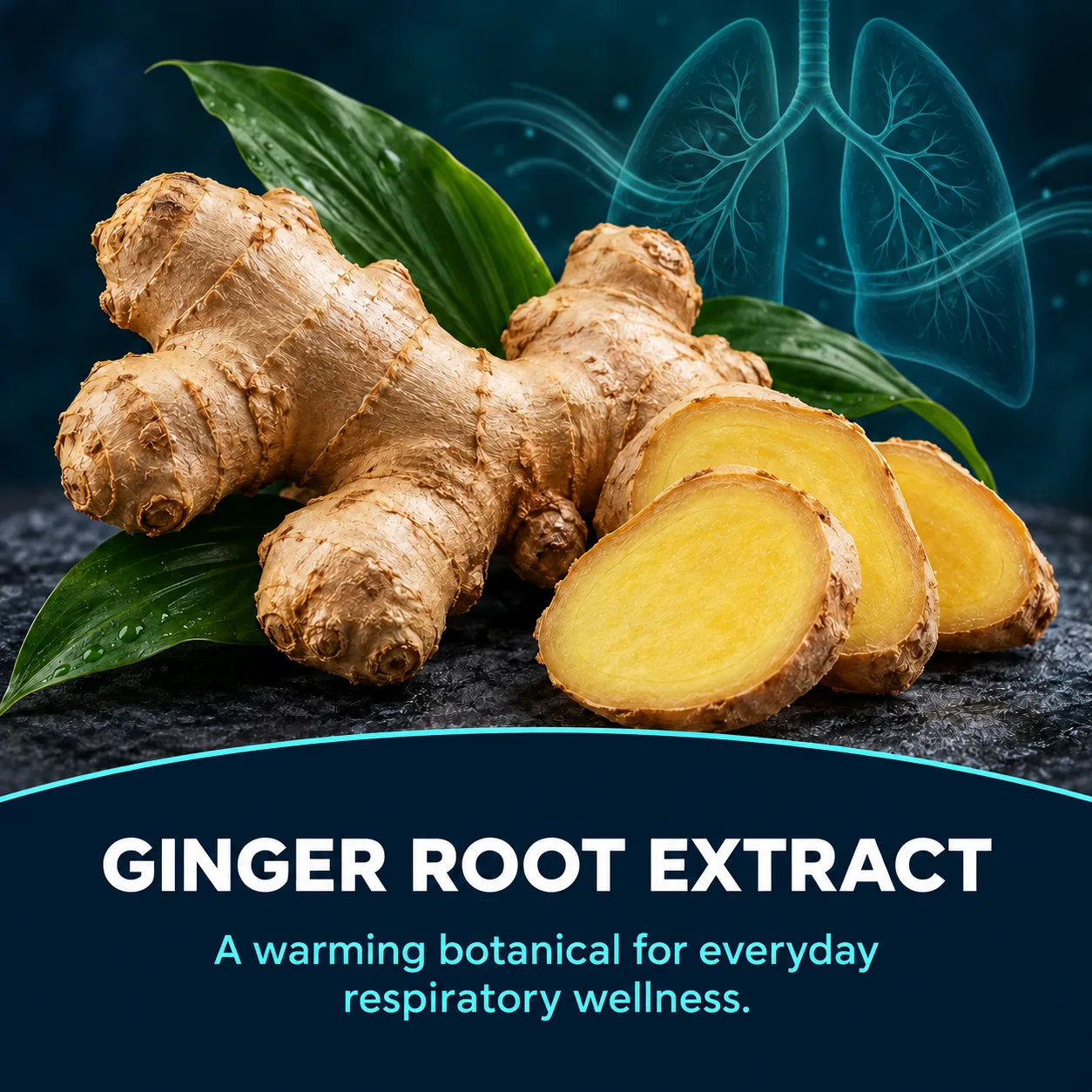
Ginger is probably already in your kitchen. It's in stir-fries, holiday cookies and the ginger ale your mom handed you when you were sick. What most people don't know is that ginger also has one of the most interesting research stories of any botanical connected to the airways.
The Columbia University discovery
A team of researchers at Columbia University wanted to know whether ginger has any direct effect on the airways. They took small strips of human airway muscle, caused them to tighten in the lab, and then added purified compounds from ginger.
The muscle relaxed. Digging deeper, they found the effect came from specific compounds — 6-gingerol, 8-gingerol and 6-shogaol — which worked by blocking two enzymes involved in keeping airways contracted. Interestingly, one related compound, 10-gingerol, did nothing at all, which suggests the effect is tied to particular molecules rather than ginger in general.
The same researchers also found the ginger compounds boosted the effect of a common airway medication rather than interfering with it.
Sources: Townsend et al., Am J Respir Cell Mol Biol 2013 · Townsend et al., 2014
The important fine print
This research was done on tissue in a lab dish — not on people taking ginger by mouth. When you swallow ginger, your digestive system and liver break those compounds down quickly, so much less reaches the rest of your body. No human clinical trial has yet shown that oral ginger improves breathing.
Fresh ginger vs. dried ginger
Here's a fun detail: fresh and dried ginger aren't chemically the same. Fresh ginger is rich in gingerols. When ginger is dried or heated, some of those gingerols convert into shogaols. Both types of compound appear in the research above.
Where ginger's evidence is strongest
Ginger's best-established human benefit is for nausea — including motion sickness and morning sickness — where it's been tested in many trials. Its general anti-inflammatory activity also has reasonable support.
Safety notes
Ginger is generally well tolerated, though some people get mild heartburn. Because it can affect blood clotting, talk to your doctor before using ginger supplements if you take warfarin or another blood thinner. The same goes for anyone managing blood sugar or blood pressure with prescription medicine.
Warming Ginger, Every Morning
BreathiZen® pairs ginger with mullein and lemon in one easy spray. Save up to 73%.
Save Up to 73% TodayThese statements have not been evaluated by the FDA. BreathiZen® is a dietary supplement and is not intended to diagnose, treat, cure or prevent any disease. Please talk to your doctor before starting any supplement.
← Back to home